Category: Actualité
News
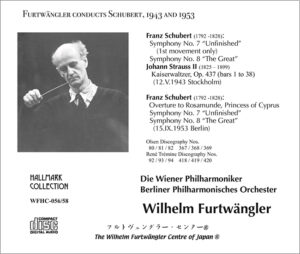
This is one of those facsimiles of programs we have been waiting for, as the concert is so emblematic of Furtwängler: his orchestra, in his concert hall, performing his repertoire, at the pinnacle of his career. It was the end of June 1943, and thanks to the recording, the event will live on forever.
The Wilhelm Furtwängler Centre of Japan (http://furt-centre.com/english/eindex.htm)
The cover, reproduced below, clearly identifies the content. No further comment, except to point out that the 1943 Stockholm Schubert concert was the subject of a product from our association (SWF D06), available as a high-definition download (€9).
The Japanese product is available at a price of 6,500 yen (around €40 or US$43), in addition, of course, to the membership fee.
One point is worth emphasizing: the mastering was carried out with both orchestras (Berlin and Vienna) on the same pitch, A = 443. We’ll come back to this point shortly, as it is the subject of much debate.
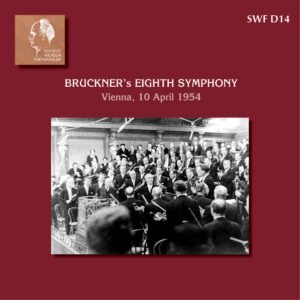
You may find our new product in the shop, and available for streaming:
SWF D14
As already mentioned in the last two news items (22 March and 29 March), this is the recording of Bruckner’s 8th Symphony on 10 April 1954, in Vienna. 70 years ago…
You will appreciate the outstanding sound we have been able to obtain from the tape, and by the work of Christophe Hénault, who has managed to erase many of the ‘scoriae’ that tainted the music.
On the home page, you’ll find a link to a podcast produced by Guilhem Chameyrat, in which our President, Félix Matus-Echaiz, speaks with Jean-Claude Hulot, music journalist and Bruckner specialist. This podcast is also available to download in the digital pack (and: https://youtu.be/a1KU47jbpiY?si=plGjCra_-vwEETQn), along with:
– audio files (HD and CD quality),
– a digital booklet (in French and English), with a text by Mark Kluge, and many photos,
– an article about technical aspects, A tribute to the C12, pdf format,
– pdfs of the cover and inlay card, for those wishing to burn a CD (attention: over 80′ of music),
– a facsimile of the concert programme.
Lastly, a wish. We have been releasing albums (the recent ‘Lucerne’, the ‘Stockholm Ninth’ etc.), but we haven’t had any feedback… You are welcome to write a comment to this article. Feel free to do so!
We are constantly updating our list of concerts. And some of our members reply to the “wanted notices” we post in the news. This was the case for the concert with the Blüthner Orchester in 1915.
Why is this so? The work carried out over thirty years ago by René Trémine, supplemented by other discoveries — in particular the BPO’s list of touring concerts — still constitutes a reliable and exhaustive base, the source of the list of our site.
But the availability of programmes on major orchestras’ websites (Vienna Philharmonic and Symphony, New York, Frankfurt…) and above all the digitisation of newspapers from the period mean that it is possible to compare the programmes announced — and often included as such in the ‘list’ — with the reality of what was actually played, with changes, or even astonishing surprises, that we are eager to incorporate into the database.
Two examples, just for Mannheim, in February 1919:
– On the 8th: the list announced, with pianist Lili Koppel performing, Schumann’s Concerto and Liszt’s Fantaisie hongroise. In fact, the Orchestra and Furtwängler performed Hungaria, Liszt’s symphonic poem, while Koppel, with the same orchestra, performed the Konzertstück opus 40 by Cécile Chaminade as well as Schumann!
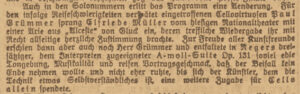
– On the 18th: cellist Paul Grümmer was scheduled to perform Eugène d’Albert’s Cello Concerto, a premiere in Mannheim. However, due to travel problems, he was replaced at the very last moment by soprano Elfriede Müller (from the Nationaltheater), who sang an aria from Gluck’s Alceste. But surprise, surprise: Paul Grümmer had just arrived and, replacing the concerto, he performed Max Reger’s Suite for Solo Cello, in A minor, Opus 131 No. 3, which had also been included in the programme.
It’s always comforting to think that we still have something to grind.
We recently announced the release of our next product: Bruckner’s 8th Symphony from 1954.
The audio quality of the recording is exceptional, comparable — to stick with the same period — to the Paris concert in May (Radio-télévision française) or Beethoven’s 9th in Lucerne (Swiss Radio).
Why? The answer is one word: the C12.
What lies behind this acronym? Read more.

SWF D14 to be released: Bruckner’s 8th from 1954
SWF is releasing a recording of Bruckner’s Eighth Symphony, made during a concert in Vienna by the Wiener Philharmoniker on April 10, 1954.
Released on April 10, to mark the 70th anniversary of the concert
This performance has not been well received. When it was first published forty years ago, it even raised doubts: what if it were a fake? No, it is indeed a Furtwängler concert — and his last 8th — but the audio quality of this recording was so deplorable that it tended to be dismissed as a foul-smelling item.
But afterwards, the recording’s fate changed, with some very good reissues, and one might wonder whether listeners were struck by deafness. This performance must be heard in the exceptional sound of the recording: phenomenal dynamic gradations ranging from the edges of silence (solos at the end of the Adagio) to the volcanic eruptions of the Finale; a very wide sound spectrum; and an infinite palette of colors… A forthcoming article will shed some much-needed technical light on this.
On closer listening, we discover a performance that matches the conductor’s most recent interpretations of Beethoven, Schubert and others — typical of his latest style. Without the excesses of a Celibidache, Furtwängler deploys ample gestures, while remaining perfectly spirited, without the stress of the 1944 interpretation (due to the war). The pinnacle is undoubtedly the Adagio, a vision of another world… He has been criticized for using the “Haslinger” score, i.e. the first edition of 1892, and not the “Haas”. Furtwängler was no great admirer of Haas, and it is unclear whether the Philharmonic had the appropriate material. However, as in 1944, Furtwängler made his own slight amendments to the score. Christophe Hénault has devoted all his care to bringing this product to life, notably by removing wowing, tape skips and noises that interfered with the musical content, but without affecting the exceptional sound quality, as exemplified here (Beginning of 2nd movement. Warning: mp3).
This concert will be available for streaming (HD and SD), but we highly recommend downloading it. The digital pack (€10 ) will include:
– a comprehensive booklet with a text by Mark Kluge,
– with inside: a number of previously unpublished snapshots (rehearsals and concerts), such as the one below,
– a technical paper about recording,
– a facsimile of the programme,
– a podcast interview with Bruckner specialist Jean-Claude Hulot (Diapason, Res Musica…).
Wikipedia, the high priest of supposedly reliable information, states in its French article about the 8th Symphony, with reference to this recording: « The 1954 [version] is to be avoided: the interpretation lacks tension and the acoustics are poor… » Let the writer of this laconic judgment listen to the SWF publication!
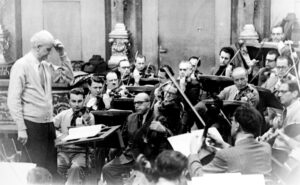
Rehearsal, April 9, 1954
Here is — click here — a facsimile of the programme of October 13, 14 and 15, 1940 at the Berlin Philharmonic.
It features an — exceptional if somewhat forgotten these days — pianist, Eduard Erdmann, already mentioned on this website.
Along with Furtwängler, he performed Chopin’s 2nd Concerto, as part of concert devoted entirely to Romantic music: Weber’s Oberon, Tchaikovsky’s Pathétique, and… Pfitzner’s Opus 46.
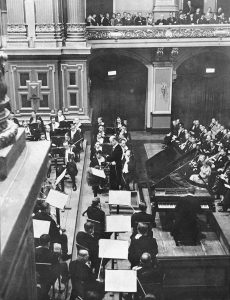
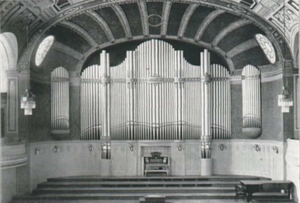
In the news article of February 22, we raised an enigma: did Furtwängler perform in Berlin as early as 1915, long before he performed with the Philharmonic?
Investigations brought results: yes, Furtwängler did conduct the Blüthner Orchester in 1915. It was on March 19, in the Blüthnersaal photo below, for a charity concert to support survivors of the Navy.
Performing with him were Joachim’s pupil, violinist Waldemar Meyer (1853-1940), Austrian soprano Hedwig Francillo-Kauffmann (1879-1948) and baritone Sydney Biden (1873-1957).
The programme (compiled from articles):
– Gluck: Overture for Alceste,
– Beethoven: Leonore III Overture
– Strauss: Tod und Verklärung
– Mendelssohn: Concerto for violin (W. Meyer)
– with Hedwig Francillo-Kauffmann:
– Haendel: Aria with flute, from L’Allegro, il Pensieroso ed il Moderato,
– Verdi: Aria from Traviata and/or Meyerbeer: “Ombre légère” from Dinorah
– with Sydney Binen: Beethoven: “An die Hoffnung” (orch. Mottl)
Selling off the stock of CDs and closing the box
You may have noticed some changes and new features here: a new look for the site, the introduction of streaming and the launch of the YouTube channel.
Now we’re making another major change: as the title says, we’ve decided to sell off our stock of compact discs and close the storage space (a car park box).
Of course, it is your right to know the reasons for this.
Sales of our CDs have fallen off sharply over the last 2 or 3 years. At present, they barely cover a third of the annual cost of our box (rent and insurance), so we’re losing several hundred euros a year — money we could use better elsewhere.
On the other hand, since 2017 we have stopped publishing physical media and moved towards downloading, supplemented by streaming. The references currently on CD will not disappear: they will gradually be streamed. In a way, this change is a logical follow-up to those made since the last General Meeting, during which we promised you a renewed and modernised SWF.
To clear our stock, which still contains more than 4,000 items, we are offering a final sale consisting of a pack (SWF 2024) containing one copy of each available reference of the French society’s CDs, referenced SWF xxx. — View the catalogue
To order : SWF 2024
The price is €30
Shipping costs of €10 (France/EU/Switzerland/Monaco) or €20 (rest of the world) will be charged in addition.
This special promotion runs from March 1 to March 22. Orders will be dispatched between 23 March and 10 April.
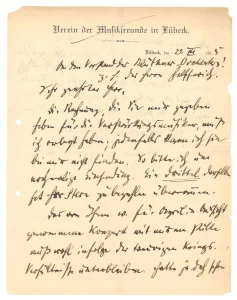
Among the many autograph letters by Furtwängler available on online sales sites, there’s one that strikes a nerve among us Furtwänglerologists. It is dated March 29, 1915, and addressed to the director of the Blüthner Orchester, from Lübeck, where Furtwängler was the conductor of the Verein for a few more weeks.
This very independent ensemble from Berlin, founded in 1907 and merged with the Berlin Symphony in 1925, had a very adventurous programming strategy involving young conductors and soloists. Eugène Ormandy performed there at the age of 18, and Edgar Varèse premiered one of his first works.
In the letter, Furtwängler mentions the invoice he received from the Orchestra (which he no longer finds) for the hiring of extra musicians, and ends the message with the request to kindly express to the musicians his gratitude and satisfaction for the concert…
Which concert? The lists documenting the conductor’s activity from 1906 to 1954 place Furtwängler’s first appearance in Berlin on December 14, 1917, conducting the Philharmonic. However, the terms of this letter are explicit: he conducted a concert in March, or even February, more than two years earlier, leading the Blüthner Orchester.
Can anyone give us some information?
We were about to pusblish a wanted notice…
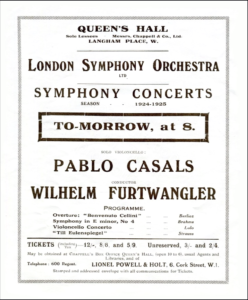
We found the following poster on the Internet, which caught our attention and made our thoughts wander. This was in London, in the 1924-1925 season of the London Symphony. It informs us that tomorrow — yes, tomorrow, but what date? — Furtwängler will conduct a fine program including Lalo’s Cello Concerto, performed by the great Pablo Casals.
But this concert was not on any list. Not even in John Hunt’s Furtwängler and Great Britain. So what happened? Was the concert cancelled?
Fortunately, the LSO archives are well kept — thanks to Libby Rice — and we now know that this concert did indeed take place, on November 24, 1924, four days after another with the Royal Philharmonic.
Our database has been updated.
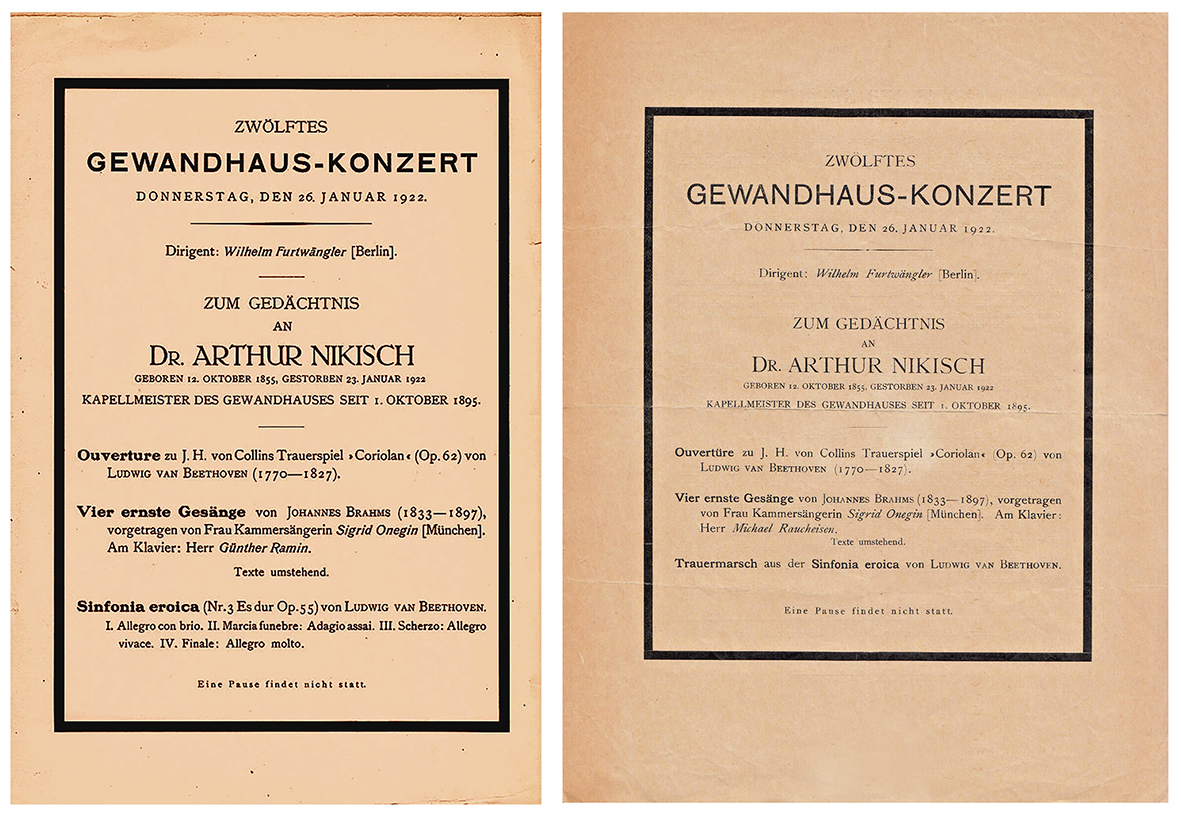
When Furtwängler arrived in Leipzig at the end of January 1922 for a concert scheduled for the 26th, the news was already in: Arthur Nikisch had died the day before. The concert therefore shifted to a commemorative tribute, and the programme changed: Coriolan, Brahms’ Vier ernste Gesänge with Sigrid Onegin, and the Eroica.
Nevertheless, some (notably the family) thought the complete performance of Beethoven’s 3rd Symphony was unwelcome, while only the slow movement — the Marcia funebra — or even the 1st movement, seemed appropriate.
The programme, already printed, was once again modified, leaving only the Funeral March from the Eroica, with Michael Raucheisen replacing Günther Ramin to perform with Sigrid Onegin.
Here are the two front pages of the programmes. Before and after.